GIACOMO Abbruzzese on disco boy
BY AGLAIA DEMENTEVA
To leave everything behind. A body emptied out in order to become another. A name that is lost. A language that is no longer enough. Tattoos that do not decorate: they allow one to be read by others.
Something disappears - clothes, objects, documents - but something remains. Not as memory, but as a mark. Like a gesture that returns. Like wild grass.
“The body is memory, expression, and at the same time, mystery.”
In Disco Boy, transformation is not an idea: it is a physical experience.
We spoke with film director Giacomo Abbruzzese. He was born in Taranto, southern Italy. He has lived in Palestine, Berlin, Montreal, and Paris.
Moving between places and languages is not only a biography: it is a form of perception. Returning makes visible what once seemed natural.
His first feature film, Disco Boy, starring Franz Rogowski, premiered at the Berlin International Film Festival, where it received the Silver Bear for Outstanding Artistic Contribution.
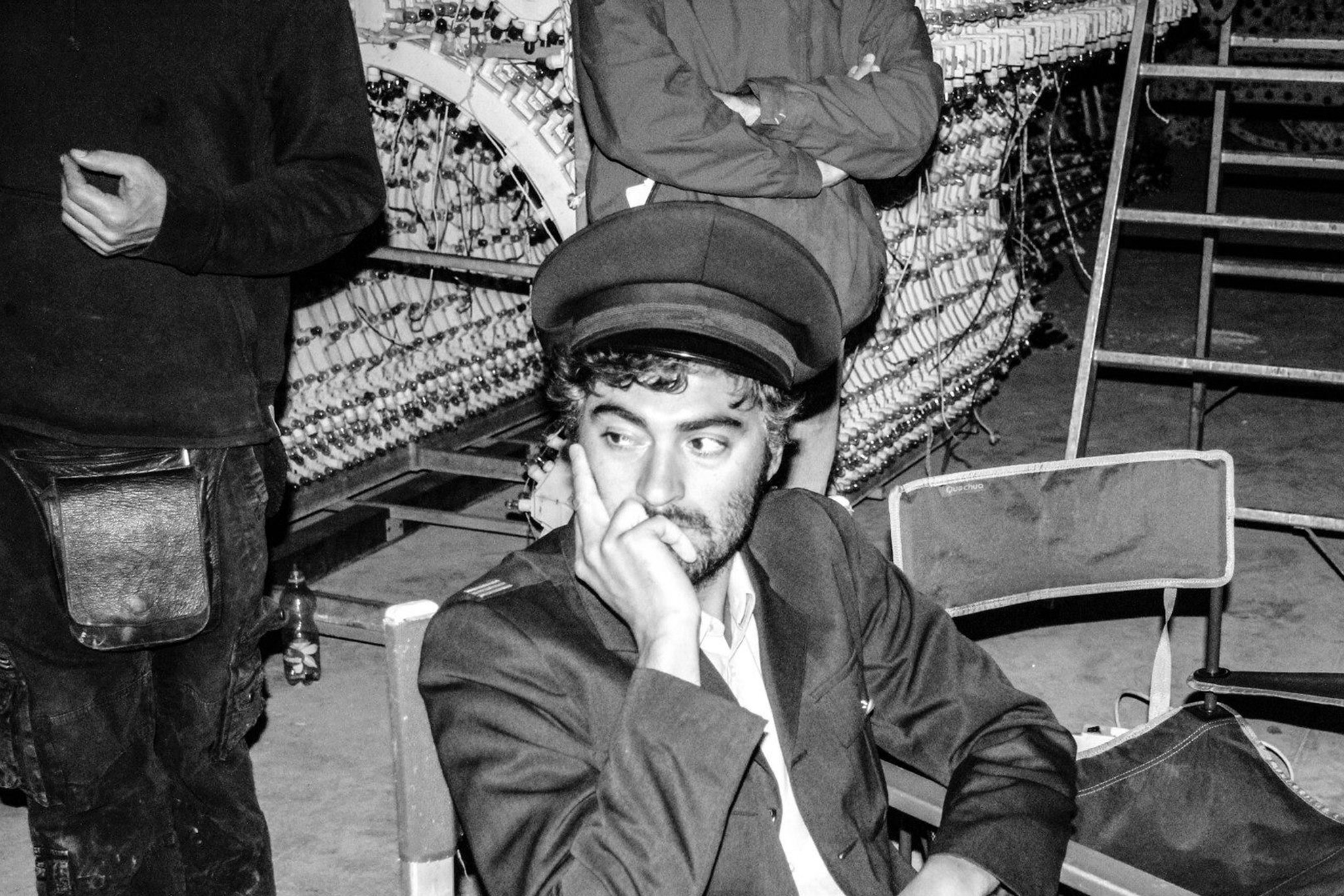
Image by Angelo Liuzzi
A: In Disco Boy, some things disappear (clothes, objects, documents) while others remain in the body, as if certain forms of memory could not be confiscated. How did you think about that tension between what is lost and what remains inscribed?
G: I was very struck by this moment in the selection process for the Foreign Legion where candidates are asked to leave everything behind. It’s extremely violent - it evokes imprisonment, even concentration camps. Stripping someone of all their belongings can be devastating. At the same time, here it also represents a new birth. A metamorphosis of the body that can only take place by leaving everything behind. But something always resists, like wild grass ready to grow back.
A: I was also struck by the tattoos, which at certain moments seem to become a form of communication with the other. What interested you in exploring through that kind of dialogue?
G: I’m interested in tattoos when they are not decorative, but when they reveal something deep about the character. Aleksei has the Madonna and Child tattooed on him; in a way,for me, it already inscribes him within a certain universe. And this happens without words, simply through the body.
The same goes for the Cyrillic tattoo on his neck, which is a prison code indicating that he is an orphan. It allows a character as opaque as Aleksei to become immediately legible to those who understand the codes, to those who belong to the same world - in this case, the nightclub owner, Gavril. The spectator cannot recognize everything, but is invited to learn, to embark on a journey.
A: In the film, migration seems to transform not only a biography, but also a sensibility. How did you think about the relationship between displacement, sensation, and perception?
G: It’s something I have experienced myself firsthand. I’m Italian, but I’ve been living in Paris for fifteen years. Before that, I lived in Palestine, in Berlin, in Montreal.
I come from a working-class background, so this path was anything but obvious. Living elsewhere - within another culture, whose language I didn’t even speak, and which could be more or less distant - has certainly enriched my way of seeing. Returning home, to Taranto, in Puglia, I began to notice things I had never observed before. What I had taken for granted, what I thought was normal, was not normal at all.
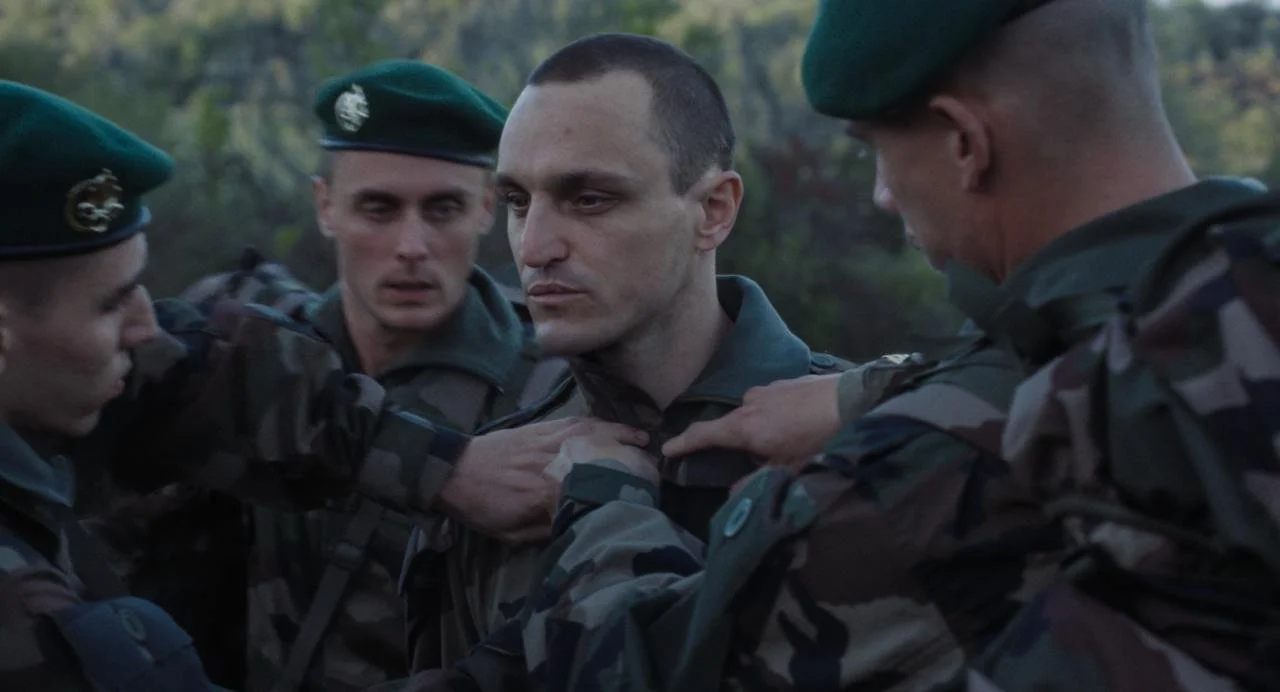
Alexei (Franz Rogowski) in Disco Boy
A: Conflict appears in the film in a way that is far from explanatory, almost as something that filters into intimacy and into the very texture of experience. How did you approach that way of making the political visible?
G: I try to make political films in a way that is not self-exonerating, without seeking consensus or consolation, and with an approach that always moves toward a form of abstraction and poetry.
I don’t want the audience to feel they are right, or that they are on the right side of history after watching one of my films. I want a viewer who questions themselves first and foremost - their own gaze, their way of being in the world - while avoiding any hasty judgment of the characters. On the contrary, I try to immerse the spectator in the perspective of the protagonist(s). It’s one of the most powerful things cinema can do: to enter the other, to restore a plurality of gazes.
A: Sometimes the gaze of a foreigner makes it possible to see certain things in a place more clearly, or differently. What kinds of things do you feel become visible only through estrangement
G: I believe in the banality of horror. The most atrocious things are hidden within normality. Having a mobile gaze, one that is somewhat disembodied from a specific place or culture, allows us to see beyond the surface of what appears normal. It breaks a kind of sclerosis to which no one is immune.
A: In the film, the relationship with the other seems to be shaped less through dialogue than through physical proximity, observation, a kind of contagion. What drew you to that form of connection?
G: Perhaps it comes from my own immersive experience, which is based more on observation than listening. It stems from something that happens at an epidermal, sensory level. I’m drawn to a cinema and a theatre of the body. The body is memory, expression, and at the same time, mystery.
I like dialogue in cinema when it is not informational—when it takes us elsewhere, through a long digression, or when it manages to be poetic without seeming so. What interests me most in art is how it creates unexpected connections, a feeling that emerges from an unforeseen association.
